W3DS-Agro

Web 3.0 Data Space for agriculture

W3DS-Agro takes data, IT systems and reporting off the farmer's back.

It does that by separating the records from the platforms that collected them and handing them back to their owner. The farmer keeps one eVault; every system reads and writes it with permission — so nothing is typed twice, nothing is locked in, and the returns come out of data that already exists.

Why this exists

Whoever owns the data sets the rules

A farmer's data is scattered across the systems that happened to collect it. Field boundaries in the registration software, spraying in the agronomy package, yields in the machine manufacturer's cloud, soil results in a PDF from the lab. Every system keeps its own copy, the copies drift apart, and none of them is the original.

It costs the farmer three times over. Once in re-entry: the same field, the same crop, the same figures keyed into one more system. Once in lock-in: changing supplier means exporting what can be exported and re-typing the rest, so most people stay where they are. And once in reporting: nutrient balance, crop protection record, certification scheme — each put together by hand out of data that already exists.

W3DS — Web 3.0 Data Space — turns it around. It separates the data from the platforms and gives it back to the person it belongs to. The farmer's records live in an eVault of their own instead of inside whichever application collected them. Software is granted access to that eVault; it no longer holds the data, and the farmer decides who reads what and can withdraw the permission.

That settles all three. Draw a field once and every system has it. Change provider and nothing has to be moved — you grant access, you take it back. Reporting is worked out from the original records instead of being filled in.

No single product gets you there. It takes an adapter the existing platforms can live with, data worth reading, and services that prove the point on a real farm in a real season. Each project below takes on one of those jobs.
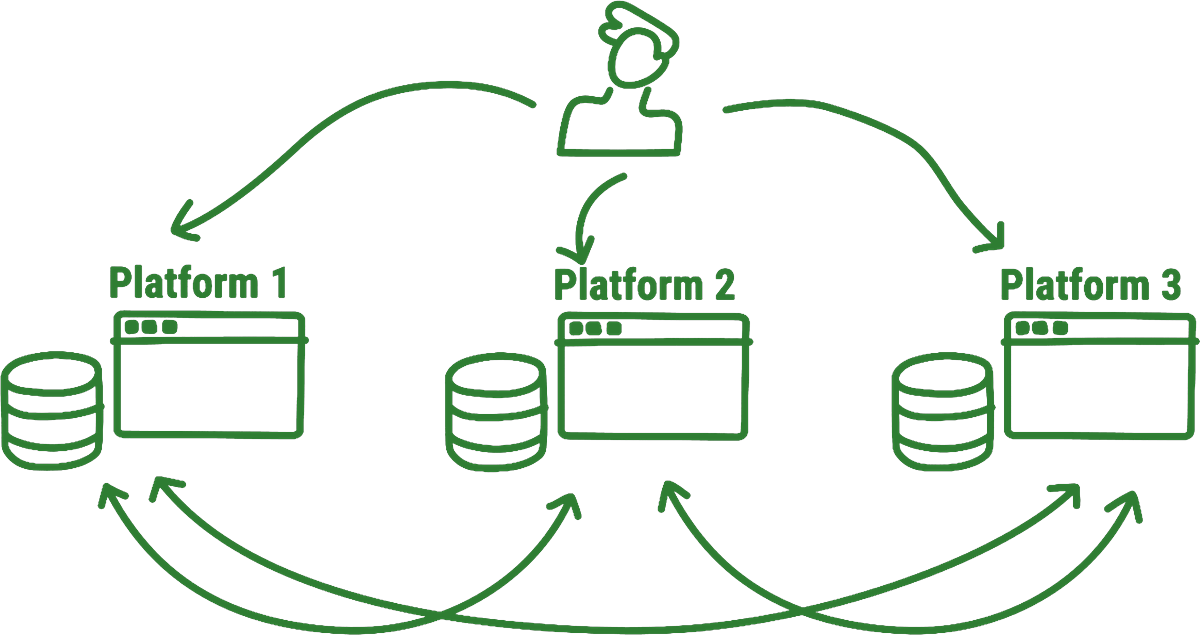
Today

Today: a farmer signs up to each platform separately; every platform keeps its own database, and data is shuttled between them

Every platform keeps its own copy, and moving data between two of them is a separate arrangement each time.

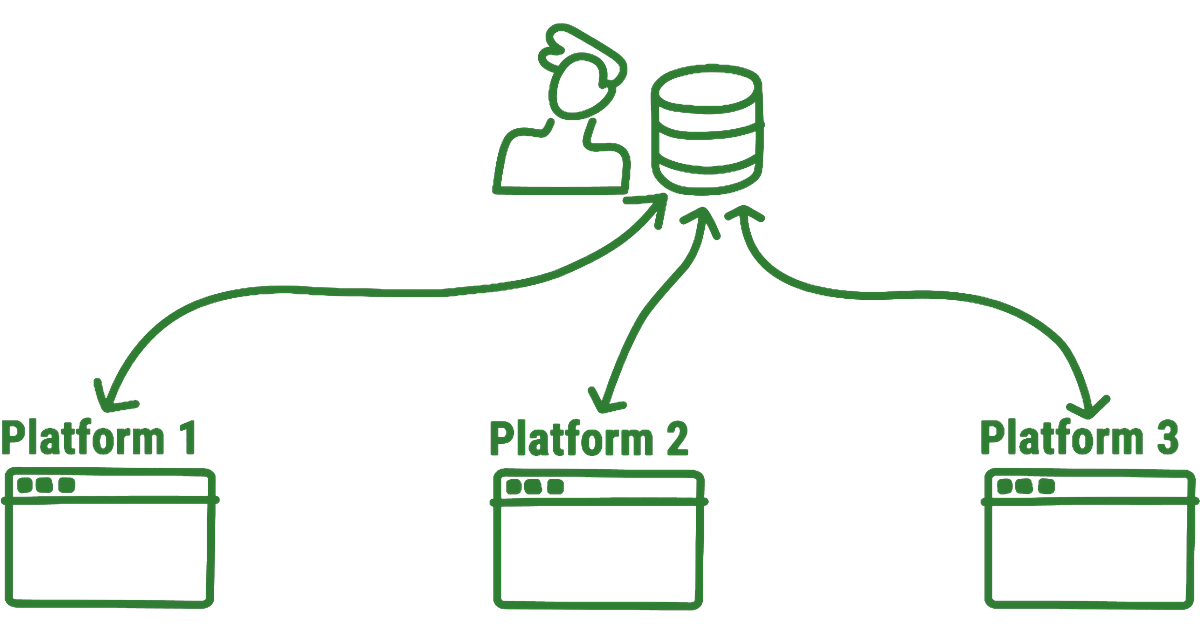
With W3DS

With W3DS: the data sits in the farm's own store, and the platforms read and write it from there

One original, held by the farmer. Platforms read and write it on the farmer's terms.

The architecture and the specifications, in full: the W3DS library · Post-Platforms Foundation · W3DS2026 conference

The ecosystem

Projects already running on W3DS

The architecture takes work off the developer as well as the farmer. Storage stops being theirs to run and to answer for: the records sit in the farmer's eVault. Identity goes the same way — no accounts to create, no passwords to reset. And every farmer arrives with their data already in hand, so onboarding costs nothing and a new user has nothing to fill in before the application is of any use.

That is why the number of applications on W3DS is growing quickly, and why it compounds: more interoperable applications bring in more farmers, more farmers bring in more kinds of data, and more data makes the next application worth building.

These are the agricultural ones running today.

Public fundingEIP Digitalisering2025–2027

W3DS Akkerbouw

The ground floor. An adapter that lets the systems a farmer already runs — field registration, agronomy, accounting — read and write one shared eVault, so a record entered once is a record everywhere, and no platform has to be replaced to join. Dutch arable farming is where it is being proven: prototype in 2025, pilots through 2026, and a target of 30 committed partners by the end.

Partners

Difco International · BO Akkerbouw · Post-Platforms Foundation · Farmmaps · VAA Data Works

Funded by

The European Union and RVO, under EIP Digitalisering

eip.akkerbouw.w3ds-agro.eu
Public fundingEIP Noord-Holland2026–2027

AI Weed Library

A weeding robot is only as good as the pictures it learned from, and those pictures sit on scattered hard drives at growers, contractors and robot builders. This project pools them: the images, the annotations drawn on them, and the models trained on both — searchable in one library, each contribution still owned by whoever shot it. Today it holds field photos from Dutch farms under crop and weed labels; annotations and models follow.

Partners

Post-Platforms Foundation (coordinator) · Difco International · Maatschap Broersen · J.C.J. Ruiter-Wever · PuurBio

Funded by

The European Union and the Province of Noord-Holland, under EIP Noord-Holland

eip.ailib.w3ds-agro.eu
Public fundingPrivate fundingEIP Noord-HollandSign in with eID

Amethyst

This is where weed imagery is outlined, plant by plant, and turned into the models weeding robots run on. Annotators sign in with their eID, and AI tools draw a first outline from a single click. Underneath it is CVAT, the open-source annotation tool, adapted to W3DS so that the images stay with whoever owns them and the work stays with whoever did it.

Partners

Post-Platforms Solutions · Post-Platforms Foundation · Difco International

Funded by

The European Union and the Province of Noord-Holland, under EIP Noord-Holland (the AI Weed Library project), and private investment

amethyst.postplatforms.com
Private fundingOpen to anyone

NL Agro Map

Soil, geomorphology and crop data for the whole of the Netherlands on one map, open without an account. Sign in with an eVault and your own fields are drawn on top, with what has been recorded on them — which is also how the imagery in the weed library is placed on the ground it came from.

Built by

Post-Platforms Solutions

Funded by

Private investment, outside the public programmes

nlagromap.postplatforms.com
Private fundingBiodiversity

Biodiversity Monitor Akkerbouw

The BMA scores an arable farm on biodiversity: field margins, rest crops, rotation, green cover, species diversity. Normally each figure is assembled by hand once a year. Here they are computed from the records already sitting in the eVault, and they move when the records do — which is what the whole argument looks like once it reaches a form someone actually has to file.

Built by

Difco International

Funded by

Private investment, outside the public programmes

bma.w3ds-agro.eu

Your project here

Building something for agriculture that needs farm data? The eVault, the adapter and the ontologies are already standing — and so is the subdomain.

Get in touch

For developers

W3DS is an open architecture

It lets any application work with the same data, under the control and the permission of whoever owns that data. The full documentation is at docs.w3ds.metastate.foundation.

For a developer it means that data and identity management are part of the new internet itself rather than of your application. The work goes into better functionality instead of into acquiring users, collecting their data, and answering for keeping it.